Lieven Van Belle, Director of Social Innovation at Beweging.net (Belgian Christian Workers' Movement), who was part of the delegation from WSM and Mutualité Chrétienne (MC) present at the event, summed up the week as follows: "For me, this Forum sends a strong signal: civil society is a driving force for social innovation and social justice. Always for, by, and with the people, because real change begins where solidarity and humanity take center stage."
Despite the threatening international context, which has seen the resurgence of armed conflicts, the crisis of multilateralism, and drastic cuts across the board in development aid and social assistance for these solidarity initiatives, the commitment, passion, and hope of the participants have remained intact.
The Social and Solidarity Economy, a tool for peace
Thus, it was strongly asserted at the Forum that the SSE is a formidable vehicle for peace, unlike capitalism, which causes wars and conflicts. This is evidenced by the drastic increases in arms budgets that many states and regional blocs have embarked upon. Through the cooperation and solidarity that these exchanges generate, the SSE enables populations to prevent and resolve conflicts. (see The BordeauxGSEF2025 Declarations are here! | GSEF)
Hope also came from a large delegation of young people who emphasized the SSE as an essential tool for sustainable human development and peace between peoples, while stressing the urgent need to take action on climate change. (see The BordeauxGSEF2025 Declarations are here! | GSEF)
For this edition of the GSEF, WSM, MC, and the INSP!R network were keen to collaborate closely with the international networks RIPESS (International Network for Social and Solidarity Economy) and WIEGO (Women in Informal Economy: Globalized and Organized). In addition to a workshop on the exchange of best practices organized the day before the GSEF, this coalition of organizations and networks consulted and prepared in advance to participate in more than 20 panels and round tables during the Forum. A joint Manifesto was published and distributed during the Forum, summarizing the key messages of these organizations and networks (see box).
The Social and Solidarity Economy, a lever for universal social protection and access to healthcare
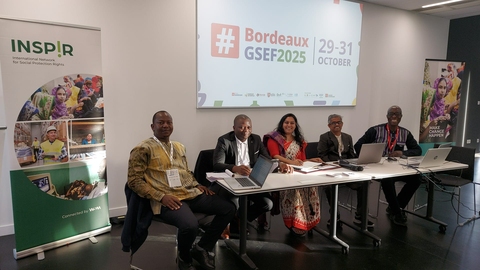
WSM, MC-MC, and the INSP!R network, supported by partner organizations “RAMS “ (Réseau d'Appui aux Mutuelles Sociales, Burkina Faso) and ”MDB" (Mutuelle Pour le Développement à la base, Benin), represented respectively by Harouna Padiene and Espérat Tossa, were able to convey the key messages of their organizations and of INSP!R during their numerous speeches during the workshops. They affirmed that the SSE, through solidarity initiatives in the field, can contribute to access to social protection and quality care. In this regard, the important role of civil society in achieving these objectives must be recognized. (See the Study elaborated by KU Leuven, in collaboration with WSM “ How the Social and Solidarity Economy can promote (the right) to social protection".
Harouna Padiene (RAMS) stated: "Mutual health insurance companies are key players in the social and solidarity economy, essential for providing access to quality healthcare and social services for all. We organize support for community mutual health organizations, which enables these actors to raise awareness among the population about the benefits of joining this system. It is essential to establish an atmosphere of mutual trust, accountability, and solidarity among members. We also train these mutual organizations by offering them the technical support they need to organize their activities. The goal is ambitious: to enable everyone to live with dignity.
Espérat Tossa (MDB) added, based on his organization's experience: "We grant microloans to people across the country. We also help them develop their capacity to organize and structure themselves into cooperatives through various technical and administrative training courses. Through the partnership we have established with the APROSOC mutual insurance company, the income generated by their social and solidarity economy activities enables them to pay their health insurance contributions, thus guaranteeing access to healthcare for themselves and their families, while encouraging them to save for their retirement."
Current challenges facing the social and solidarity economy according to GSEF 2025
The 2025 edition of the Global Social Economy Forum (GSEF) highlighted encouraging global momentum around the SSE, while also highlighting the challenges the sector must overcome to amplify its impact. The first challenge remains that of consolidating financial and institutional resources to enable SSE structures to scale up while preserving their founding values. Many stakeholders are calling for more inclusive financing mechanisms, greater recognition in public policy, and easier access to public procurement and regional partnerships. The second challenge concerns participatory governance and regional recognition: the SSE must become more firmly rooted in local policy, strengthen dialogue between local authorities, community networks, and social enterprises, and promote models of shared governance.
Finally, faced with the ongoing ecological, digital, and social transitions, the sector is called upon to reinvent itself to become a driver of systemic transformation: developing green jobs, strengthening youth training, encouraging intergenerational cooperation, and placing solidarity at the heart of the just transition. The GSEF 2025 also showed that these challenges bring opportunities: a new wave of international cooperation, a mobilized youth, and local communities ready to experiment with innovative solutions. These are all signs that the SSE, far from being marginal, is establishing itself as a way forward for a more humane, resilient, and sustainable economy.
The next edition of the GSEF will take place in 2027 in Maríca, a few kilometers from Rio de Janeiro, Brazil, in this laboratory city for collaborative social economies. Until then, all SSE actors intend to continue to demonstrate their ambitions and fight for greater recognition through integrated policy frameworks, adequate regulations, and access to appropriate financing. The international framework is not entirely bleak, as two resolutions aimed at promoting and supporting the SSE were passed in quick succession in 2022 and 2023 by the International Labor Organization (ILO) and the United Nations General Assembly. These are signs that, despite turbulence and difficulties, a path forward is possible to promote greater social justice and solidarity by valuing the actions of organized civil society.
Santiago Fischer (WSM), in collaboration with Rémi Olou (WSM) and Agnès Chapelle, Valérie Van Belle & Françoise Vervoort (MC)