Accelerating Social Development: A Declaration for Decision and Action

Threats to social development are evitable
In 2015, the United Nations decided on the Sustainable Development Goals (SDGs) to profoundly transform our world, to make it resilient and sustainable. It is clear that 10 years later, many indicators of progress still remain, or have fallen into the red. In order to achieve these collective goals for human, social and environmental development, but also to ensure that people regain their dignity, it is imperative to accelerate progress.
Limited progress on Sustainable Development
The United Nations' 2024 SDG Report reveals that, on average, only 16% of the SDG goals are on track to be achieved globally by 2030, with the remaining 84% showing limited progress or setback. In Latin America and the Caribbean, if current trends continue, more than 110 million people will be living in poverty by 2030, and SDG 8, on decent work, is one of the furthest from its goal. Globally, the ILO estimates that more than 3.8 billion people (47.6% of the world's population) do not have any form of social protection. This gap disproportionately affects women, youth, migrant workers, people with disabilities and those working in the informal economy. In addition, regional disparities are wide: in Africa, only 19.1 per cent of the population receives at least one social protection benefit, while in Asia and the Pacific, the figure is 53.6 per cent.
The latest estimates come from the ILO's Global Social Protection Report 2024-2026: www.ilo.org/fr/node/664696


A Declaration that revives multilateralism
The Doha Declaration is therefore part of a collective effort to redefine our approaches to achieving the United Nations' social goals, in the face of a world that has changed dramatically. Sophie De Smedt, Permanent Representative for Belgium to the United Nations and co-facilitator of the Doha Declaration, congratulated the stakeholders at the Summit for this commitment. Although this is the result of compromises, and some aspects can be further explored, it shows a strong commitment to social development. Belgium played a key role, together with Morocco, in co-facilitating the negotiations that led to this Declaration. Multilateralism is once again showing its mobilizing force.
The opportunity was well seized by WSM, ACV-CSC, the Christian Mutualities (MC) as well as the network INSP!R[1], which represents trade union, mutuals and social organisations around the world and promotes social protection rights. The delegation of the network INSP!R was present in Doha and was able to defend the priorities focused on the necessary and urgent investments in more social justice, the achievement of the Decent Work Agenda, particularly through inclusive and adaptive universal social protection, responding to the effects of climate change and reducing structural gender inequalities in order to counteract the setbacks in human development that we are experiencing in our world in crisis.
[1] INSP! R was represented at this 2nd World Summit for Social Development, by six délégué.es of the network: Zuliana Lainez, from the ANP (National Association of Journalists of Peru), for INSP! R Latin America and the Caribbean, Elly Rosita Silaban, President of the KSBSI (KONFEDERASI SERIKAT BURUH SELURUH INDONESIA), for INSP! R Asia, Dr. Ingrid Mulamba, from the CDS (Chair of Social Dynamics) – Democratic Republic of Congo, for INSP!R Central Africa, Aisha Aissata Belem, from RAMS (Réseau d'Appui aux mutuelles de santé), Burkina Faso, for INSP!R West Africa, Santiago Fischer, Head of the Advocacy Department for WSM Belgium, Aurélie Vanossel, Advocacy Officer at WSM – Belgium. Ann Vermorgen, President of ACV-CSC Belgium, also accompanied this delegation.


Victories for Social Protection
The network INSP!R can be proud of some of the positive points included in the Declaration, including strong references to social protection as a lever for social development, the reminder of the need for the formalization of work to structure and empower people to lift them out of poverty through decent work, as well as the role that the social and solidarity economy plays for social development.
During the various parallel events, the ILO has widely recalled that there is no social development without decent work and minimum vital incomes. Various ministers present, particularly impacted by serious humanitarian situations due to natural disasters or insecurity emanating from conflicts, recalled that in addition to humanitarian support, and despite situations of fragility, the long-distance race for adaptive and universal social policies must continue to be conducted.
Finally, in a context where many discourses on gender equity are widely questioned in international forums, another key victory for our advocacy is the integration of gender in the Declaration and in many speeches.
Our voices that carry
As a network, we can congratulate ourselves on having made our various demands loud and clear in discussions and panels:
"Social dialogue is essential for gender equality. Collective agreements can help reduce wage gaps, promote family-friendly policies and combat discrimination in the workplace. »
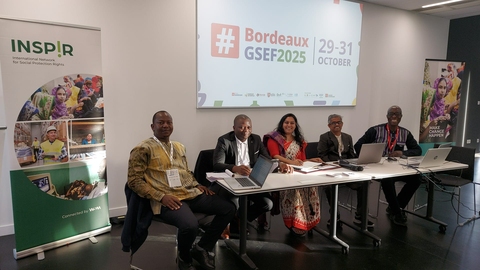
[1] International Network of Social and Solidarity Economy
[2] Read our full article on the GSEF: https://www.inspir.global/bordeaux-participants-around-world-gather-reaffirm-importance-social-and-solidarity-economy-world


A multi-crisis world requires multi-stakeholder networks
It is obvious that for the network INSP!R, it is through solidarity, cooperation and strong commitments that we will be able to advance the Decent Work Agenda and social protection. As mentioned several times during the Summit, our tool for the implementation of the Doha Declaration is to involve the social partners and civil society.
Acting as an intercontinental network in such an area of multilateralism is essential because we face, at different levels, the same concerns and attacks against our organizations. The multi-stakeholder network INSP!R allows us to strengthen ourselves and act together on different continents.
"Participation in the 2nd World Summit on Social Development was an opportunity for learning and connection to make the network's action visible and to carry out its network vision in terms of social protection. More than ever, multi-stakeholder action (governments, trade unions and civil society organizations) and the articulation between the various mechanisms (mutuality, access to income, vocational training, organization of populations) of social protection were reaffirmed during this Summit. Aisha Aïssata Belem, RAMS, Burkina Faso- INSP! R
From words to deeds
Elly Rosita Saliban, a trade unionist from Indonesia, echoes what many heads of state have called for: "We want to see the implementation of the commitments made in Doha in our countries. We can no longer leave vulnerable people behind. Zuliana Lainez of the Peruvian Journalists' Union reinforces this demand: " In this world in crisis, states must put their money where their mouth is. »
Austerity and social disinvestment cannot be the way forward. The financing solutions and alternatives to achieve these commitments are known, but the political will must become a reality.
Despite the fact that only 40 heads of state were present at the Summit (at the first world summit there were 110, which diminishes the scope of the messages conveyed), it is essential to remember that this Declaration affects all the peoples of the world, and that it is through collective and global action that we will show resilience in the face of present and future global crises.
We, civil society, must also hold our states accountable in the implementation of the recommendations made, including through follow-up mechanisms to ensure that this Declaration truly becomes an accelerator of social progress.
Together, let's change the game!
You can find all of our demands in the following link: https://www.wsm.be/files/files/publicaties/eng/WSM-depliant-Insp-r-10-2025-EN-WEB.pdf